

KEY TAKEAWAYS
Green investment banking aims to catalyze private investments into low-carbon, climate-resilient infrastructure. But how exactly?
Green investment banking aims to catalyze private investments into low-carbon, climate-resilient infrastructure in line with public policy ambitions. But what exactly is it and what is it capable of?
A changing climate is changing finance. Green investment banking is taking hold in many places throughout the world, brought on by national and local commitments to slash greenhouse gases. Green investment banks are on the frontlines of climate financing.
What is green investment banking?
Green investment banking is the practice of directing private investment into low-carbon, climate resilient (LCR) technologies and infrastructure through publicly mandated green investment banks. They aid in hastening the development of markets in renewable energy and energy efficiency. These public and quasi-public entities span the globe, serving the purpose of incubating the climate solutions of tomorrow.
The global-warming induced planetary emergency requires scalable, agile, and rapid solutions. This means that innovative technologies need to become market-ready at abnormal speeds. Left alone to market forces, many may never get off the ground or do so too late to matter.
That’s where green investment banking comes in. It’s a financial intervention that leverages investment strategies by reducing the barriers to entry and “crowding-in” private financing.
Why are governments creating green investment banks?
Many governments and municipalities have under the Paris Agreement made bold pledges to reduce emissions. Investment plays a crucial role in meeting those goals. According to the OECD from now until 2030, investments totalling $6.9 trillion a year in green infrastructure are needed to have any hope of staying below the 2°C threshold. And energy infrastructure will require roughly 30% of that investment. Attracting green investment on that in scale within a decade is a tall order. That’s where green investment banking comes in.
Green investment banks are set up with a clear and narrow mandate to speed up the process in which new LCR technologies become financially viable. From California to Malaysia, these institutions employ several strategies from their financial tool belts to reduce risk, increase investment, improve transparency, and empower investors.
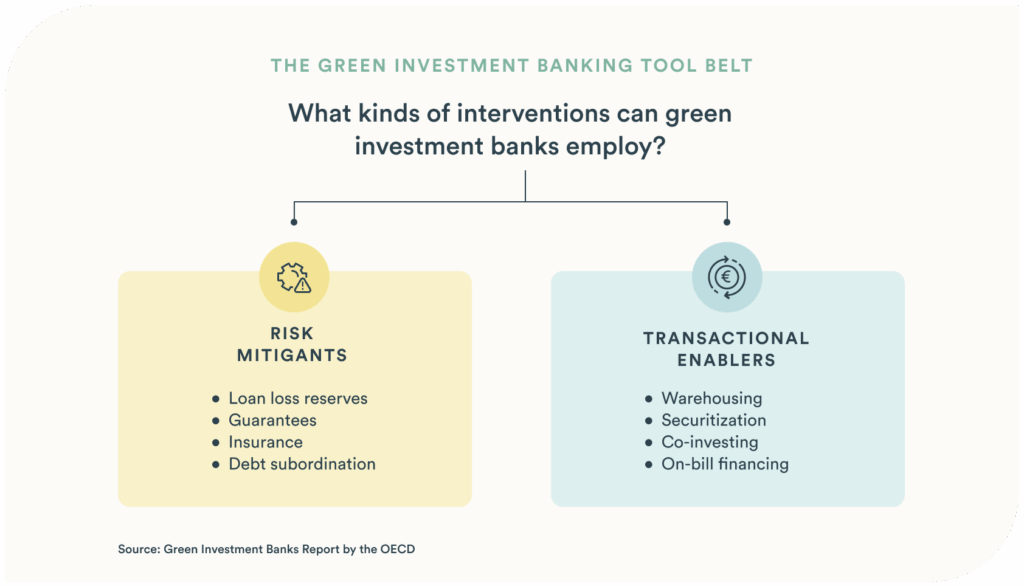
The market for climate finance is growing and 90% of this investment remains in the country of origin. Green investment banking facilitates this domestic investment by leveraging its local expertise. These banks have advanced knowledge on domestic markets, local and national regulations, and best practices. Think of them as sustainable financial gurus, aiming to bolster investor confidence.
Green investment banks are independent institutions, guided by public mandate, imbued with the flexibility to respond to market demands and developments. While it can vary, the majority of these banks are capitalized through public funds. This can take many forms, including budgetary allocations, utility surcharges, or carbon tax revenue.
How important is this kind of banking?
Return on investment is important here; new markets must prove their ability to turn a profit if they are to have any hope of attracting more private capital. In fact, some require certain profit margins to be met. The UK Green Investment Bank, for example, requires they make a 3.5% annual nominal investment return on total investments.
“Accomplishing these ambitious targets requires a planet-centric rethink, revision, and reinvestment.”
However, success for green investment banks goes beyond your traditional financial metrics. Return on investment rests at the core of any financial institution; the difference here accountability and impact are also deeply intertwined.
How to measure the success of green investment banking:
- Amount of private capital mobilized
- Reduction in greenhouse gas emissions
- Return on capital
- Gigawatts of clean energy installed
- Gigawatts of saved energy
- Market transformation
How can impact be maximized?
With each goal met, the trust in green investment banking grows. And this is important. Trust, built from solid performance, lifts investor confidence. Like kindling on a campfire, green investment banks nudge investors by offering transparency and education which help set new markets ablaze, inspiring a race to the top.
Green investment banks are a public tool that pull on the levers of capitalism to push potent, emerging solutions to the forefront, better equipping society to respond to climate change. But it’s just one mechanism in an array of climate action possibilities.
For it to be successful, green investment banking cannot live in a silo nor can it be viewed as an all-in-one fix. Its success hinges in part on the regulatory environment, whether it hinders or harnesses these kinds of financial decisions.
The International Atomic and Energy association posits that in a 2°C 66% scenario, 95% of energy would need to be low carbon, 70% of new cars would be electric, the entire existing building stock would have been retrofitted, and the CO2 intensity of the industrial sector would need to be 80% lower than today’s levels – all this in three decades.
Accomplishing these ambitious targets requires a planet-centric rethink, revision, and reinvestment. Green investment banking provides capital markets with the training wheels to get a head start on saving the future.
Author Information