
Turn Climate Risk Into Clear Financial Insight
Translate Complex Scenarios Into Smarter Decisions
Understand how physical and transition risks could impact your portfolio over time. Explore multiple climate pathways, assess exposure at every level, and take action with clarity and confidence.
Trusted by Leading Financial Institutions










Climate Blind Spots Are Investment Liabilities
Our Solution, at a Glance
Put Climate at the Center of Risk Management
Look Ahead, Understand Risk Over Time
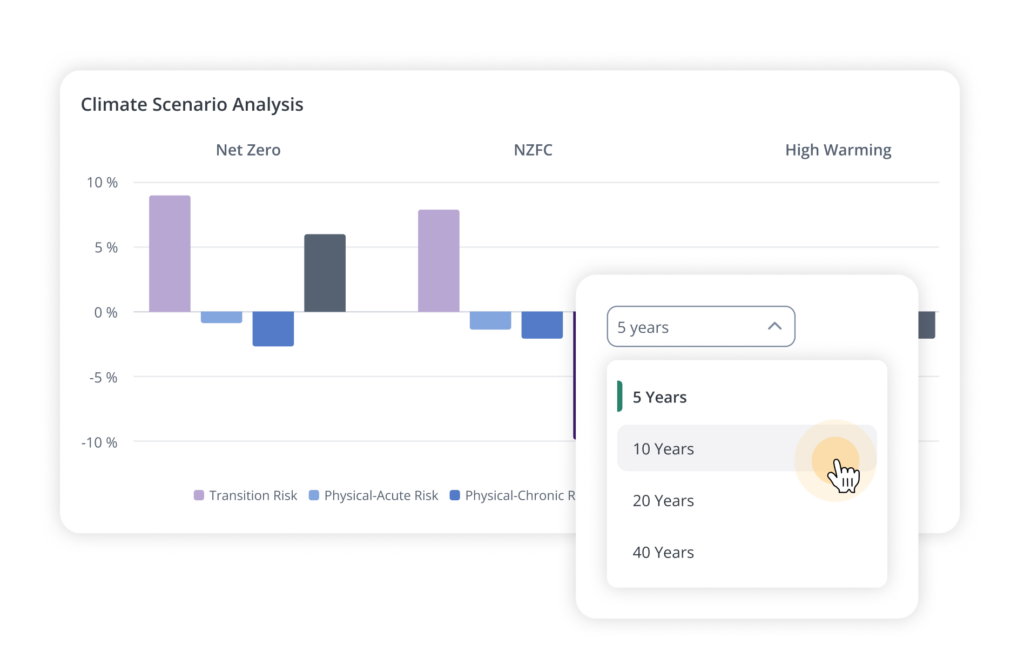
Multiple scenarios and time horizons for a complete view of climate risk:
- Explore three climate scenarios, from Net Zero to High Warming
- Assess risk over four time horizons—from short to long term
- Uncover resilience gaps in your investments across future pathways

Pinpoint Where and How Risk Shows Up
A clear breakdown of climate risk drivers to guide smarter decisions:
- Aggregated climate risk score at company and portfolio level
- Distinction between Transition, Physical Acute, and Chronic risks
- Transparent view of risk type and its potential financial impact

Cover More Ground, Miss Fewer Risks
Robust coverage to reduce blind spots across asset classes:
- Coverage of 4.9 million securities, and 128,400 organizations worldwide
- Climate risk data linked to individual securities
- Built to support portfolio-wide risk visibility and comparison

What We Stand For
Reliable Climate Data. Clearer Investment Decisions.
Systemic Risk Meets Real-World Relevance

Beyond Climate Scenario Analysis
Factor Different Metrics Into Your Risk Assessment
Nature and Biodiversity

Climate Transition

Carbon Footprint

One Solution for Every Use Case
Climate Scenario Analysis for Every Financial Institution
Strengthen Portfolio Resilience
Identify and manage climate-related risks across your portfolios with scenario-based insights. Evaluate transition and physical risk exposure to support long-term investment strategies and regulatory alignment.
Learn More
Understand Exposure, Steer Strategy
Assess portfolio alignment with climate scenarios and uncover systemic risks. Use forward-looking insights to guide engagement, policy decisions, and capital allocation.
Learn MoreSupport Client Conversations with Climate Data
Bring future risks into focus with simple, explainable insights. Enhance trust by showing how climate risks could affect investment outcomes over time.
Learn MoreIntegrate Climate Risk into Lending and Underwriting
Quantify the financial impact of climate change on counterparties. Use granular data and systemic risk models to inform lending, stress testing, and disclosure.
Learn MoreFrequently asked questions
Lorem ipsum dolor sit amet, consectetur adipiscing elit, sed do eiusmod tempor incididunt ut labore et dolore magna aliqua.
Contact UsWhat types of climate scenarios are included?
We use proprietary scenarios developed by Ortec Finance and Cambridge Econometrics, which go beyond the standard IPCC Shared Socio-economic Pathways (SSPs). These scenarios incorporate additional assumptions on policies, technologies, and sectoral/regional exposure to better reflect transition risks and opportunities. For each scenario, we provide a reference to the closest corresponding IPCC pathway—so you get both tailored insights and global comparability.
How can Climate Scenario Analysis be integrated into our systems?
Absolutely. You can access the data through Clarity AI’s web app, or seamlessly integrate it into your own systems via flexible API and data feed options with no disruption to your existing workflows.
Can I analyze risk at both the security and portfolio level?
Yes. We provide detailed risk outputs at both levels, including sector and issuer-level breakdowns. This allows you to drill down into exposures while maintaining a full portfolio view.
How are transition and physical risks differentiated?
Our solution clearly separates Transition, Physical Acute, and Physical Chronic risks. This helps you understand not only the overall climate risk but also its root causes and likely financial impact over time.
How is company-specific context reflected in the analysis?
We combine systemic scenario models with bottom-up inputs like geographic revenue exposure and business activities. This hybrid approach tailors risk analysis to each company’s footprint, offering decision-grade insights that go beyond static climate models.
Research and Insights
Latest news and articles
From Research to Stewardship: The Next Step for AI in Responsible Investment
AI already reads disclosures and news at scale for research and screening. Lorenzo Saa on why investors now want that capability extended into stewardship.

EBA Pillar 3 and Climate Stress Testing: What Changes for EU Banks
The EBA's new Pillar 3 ESG rules reach every EU bank, and climate joins the 2027 stress test. Here's what changes, who is in scope and when it applies.

ESG Ratings Regulation: What Investors Should Ask Now
The EU ESG Ratings Regulation is live. Learn what has changed for investors, where ESMA authorisation stands and the key questions to ask your rating providers.