
Nature Risk Is Investment Risk. Get the Data to Prove It.
Turn nature-related risk and impact into clear insights
Identify portfolio exposure to nature-related risks, quantify biodiversity impact, and align with reporting best practices with confidence.
Trusted by Leading Financial Institutions










You Can’t Manage What You Can’t Measure
Our Solution, at a Glance
See Risk, Show Impact, Report with Clarity
Pinpoint Asset-Level Nature Risks
Geospatial insights for more targeted biodiversity risk assessment with:
- Asset mapping across TNFD-aligned biodiversity-sensitive areas
- Risk overlays by industry using ENCORE materiality guidance
- Insight into revenue and production at risk from high-risk regions

Measure Biodiversity Footprint
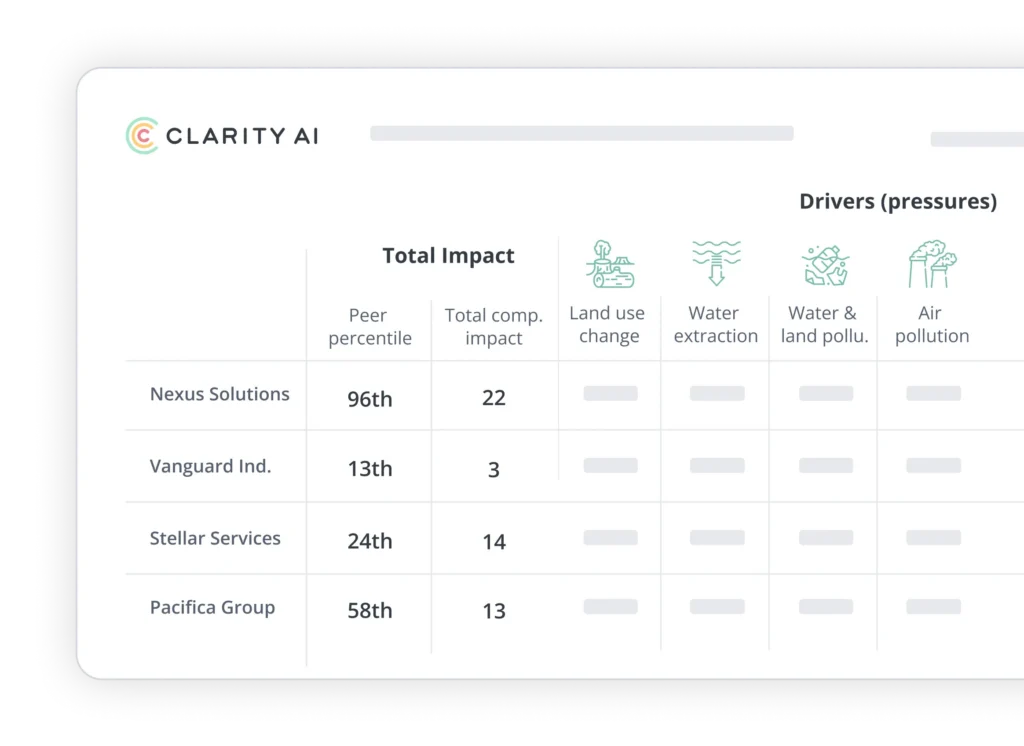
Quantitative footprinting across key biodiversity drivers and 40,000 companies with:
- Potentially Disappeared Fraction (PDF) metric across six pressure categories
- Analysis of direct and indirect impacts, including supply chains
- Historical performance to monitor biodiversity trends over time

Simplify TNFD Reporting
All-in-one reporting built for easy, TNFD-aligned disclosures:
- Core and additional indicators aligned with TNFD guidance
- In-depth portfolio and company analysis, backed by benchmarks
- Transparent source references to support credible reporting

What We Stand For
AI You Can Rely On. Data You Can Defend.
AI-Powered Precision for Nature-Related Data

Nature Data You Can Trust and Explain

Beyond Nature & Biodiversity
Expand Your Analysis with Additional Metrics
Climate Transition

EU Taxonomy

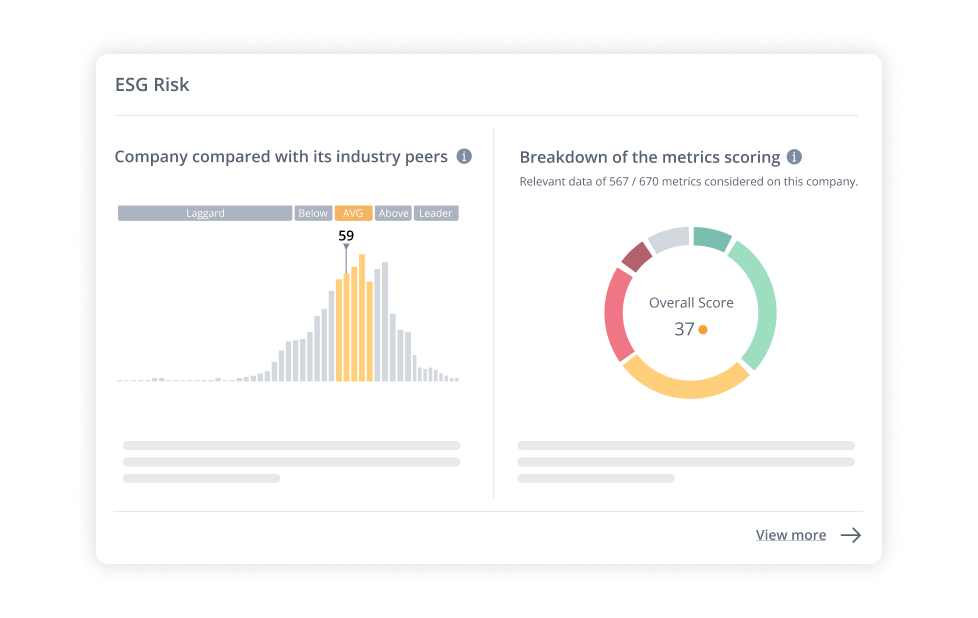
ESG Scores
A Comprehensive Nature & Biodiversity Solution for Financial Institutions
Nature & Biodiversity Insights for Asset Managers
Clarity AI helps asset managers assess nature-related risks, measure biodiversity impact, and align portfolios with sustainability goals using transparent, science-based data.
Learn More
Nature & Biodiversity Assessment for Asset Owners
Clarity AI enables asset owners to evaluate exposure to high-impact sectors, track biodiversity footprints, and integrate nature-related insights into investment strategies.
Learn MoreIntegrated Nature & Biodiversity Tools for Wealth Managers
Clarity AI helps wealth managers report nature-related risks and biodiversity impact to stakeholders, ensuring transparent disclosures and alignment with sustainability commitments.
Learn MoreNature & Biodiversity Risk Management for Banks
Clarity AI provides banks with comprehensive biodiversity data and geospatial risk assessments, helping them evaluate dependencies, mitigate risks, and support regulatory disclosures.
Learn MoreFrequently asked questions
Lorem ipsum dolor sit amet, consectetur adipiscing elit, sed do eiusmod tempor incididunt ut labore et dolore magna aliqua.
Contact UsCan you support end-to-end TNFD reports?
Clarity AI enables clients to automatically create TNFD reports covering core metrics and additional indicators as set forth in the framework guidance. Data transparency at the company level and benchmarks are also provided to heighten trust in the results.
How do you approach asset coverage for nature-related risk?
Clarity AI prioritizes asset-level coverage of production facilities that are most reliant on nature, rather than offices or industries that do not typically depend on natural resources. Our approach focuses on quality over quantity, ensuring coverage of the assets and industries most relevant for nature-related risk analysis.
How do you calculate nature-related risk?
Clarity AI includes asset-level production data in our solution, and translates this into revenue contribution based on the percentage of each production activity to the company’s total revenues. This enables users to identify assets that are the most important for the company based on how much they are producing, and the associated revenue of each asset. As a result, our solution providers a more meaningful calculation of risk based on an assets importance for a company and location, rather than only assessing if an asset is located in an area of risk.
How is the biodiversity footprint of supply chains assessed?
Our biodiversity footprint methodology includes two distinct components. The first evaluates the direct impacts of a company’s operations on biodiversity. The second assesses indirect impacts, focusing on the upstream effects within a company’s supply chain. This calculation is approximated by categorizing companies based on their economic activities and geographic revenue distribution. Unlike approaches that rely solely on a company’s primary activity or headquarters location, Clarity AI’s method offers a more accurate representation of indirect biodiversity impact.
Does Clarity AI support French Article 29 disclosures?
Yes. Clarity AI provides full coverage across key Article 29 sections, including EU Taxonomy alignment and fossil fuel exposure, climate targets and Paris-aligned benchmarks, biodiversity footprint indicators, and ESG integration in risk management. Our solution enables comprehensive reporting fully aligned with the French Law.
Research and Insights
Latest news and articles
How can institutional investors assess portfolio exposure to conflict zones
Investors are under growing pressure to understand how their portfolios connect to conflict-affected and high-risk areas. Yet data on corporate exposure that is both independent and transparent enough to trust remains hard to find. In this webinar, we will introduce our CAHRAs solution developed with asset owners across Europe. It is designed to give institutional…

Same Brain, Different Logo: The Hidden Risk of AI in Financial Markets
By now, most people can spot a novice AI-drafted email: the overused em dash, or the “here is a more human version” someone forgot to delete before hitting send. On Wall Street, the more serious problem is harder to catch, because it sits in the reasoning. And when that reasoning decides where capital goes, a…

Reconciling AI Risk and Opportunity: A Net Assessment for Investors
Anthropic’s S-1 forces risk and opportunity into one document. Most AI commentary reports one or the other. Investors can’t afford to.