
KEY TAKEAWAYS
Greenwashing in banking is prevalent. Yet, when equipped with the right knowledge, its risks and reputational harm are easily avoidable.
Whether it be carbon footprint trackers or socially responsible funds, the market for sustainable banking products and green investments is booming – and with it rises the demand for genuine and transparent corporate sustainability management. Yet tapping into the current zeitgeist does not need to end up in greenwashing. Here’s how to avoid greenwashing in banking and stand out from the crowd.
Why is greenwashing bad for banks?
Besides the obvious negative environmental impacts of greenwashing, it is also bad news for business. Although greenwashing may seem like a ‘quick fix’ to hop on the sustainability bandwagon, it’s risky business.
“42% of sustainability claims were exaggerated, false or deceptive.”
Here’s why: scientific studies have highlighted that greenwashing negatively affects business reputation in almost all cases. From bad press, decreased customer engagement and loyalty, through to losing business partners and ultimately profit loss, one thing is clear: the short-term benefits of greenwashing fade, but the long-term damages linger.
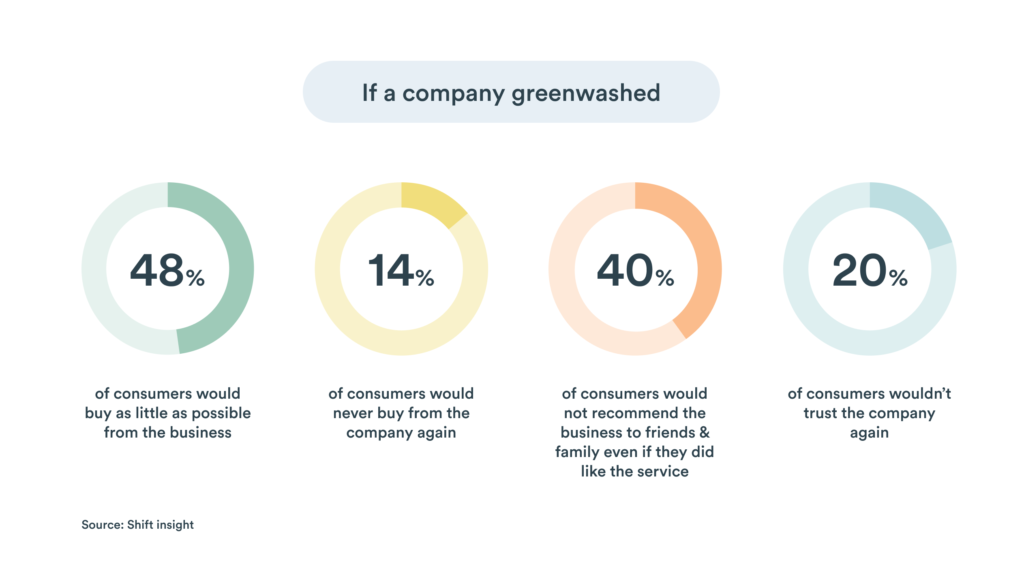
However, much more than reputation is on the line with greenwashing. In many countries, it can lead to legal complications. Australia, Canada and Singapore have implemented laws that prohibit making false or misleading claims. The EU has gone even further and is seeking to specifically crack down on greenwashing practices within the financial sector by regulating green labels through its new taxonomy. The supply for green products is growing and so are the legal frameworks in all corners of the globe.
How can greenwashing in banking be avoided?
Sustainability isn’t just a trend, it’s long overdue rethink of the status quo. And it’s here to stay. As more financial institutions navigate this new field, the risk of falling into a greenwashing trap grows.
Greenwashing culprits often find themselves in a bind on accident. Common mistakes can plunge even the most well-intentioned stakeholders into hot water: as highlighted by a study undertaken by ICPEN, 42% of sustainability claims were exaggerated, false or deceptive. Claiming your stake in a more sustainable world means aligning business practices with genuine purpose. Here are the most common ways greenwashing occurs:
- The Hidden Trade-off: a claim which suggests that a product is ‘green’ based on a narrow environmental claim which does not take into account other important environmental issues.
- No proof: A claim which cannot be backed by easily accessible and reliable proof.
- Vagueness: A claim that is so poorly defined or broad that its real meaning is likely to be misunderstood by the consumer.
- Worshipping False Labels: A product that uses labels which may seem like an environmental certification but in reality are not (e.g., the use of trees or the color green).
- Irrelevance: A claim that is technically true but irrelevant to the product.
- Lesser of Two Evils: A claim that may be true but may distract the consumer from the greater environmental impacts of the whole product category.
- Fibbing: Claims that are simply false.
Although the theory is long, when looking at these different greenwashing practices, it really comes down to two main drivers: a lack of detail and transparency. And that’s exactly how banks can avoid and need to approach greenwashing: radical transparency, not just at management level, but deeply integrated within the company philosophy.
The best way to avoid greenwashing is to embody sustainable business practices that are founded on reliable scientific evidence, made readily available to all stakeholders. Despite appearances, no one has perfected corporate sustainability. Being open to feedback and adapting new findings, however, defends your position and improves your reputation. Transparency is the most effective policy.
Now, making the world of banking more transparent doesn’t have to be difficult. At Clarity AI, we provide transparency for digital financial products through reliable data sources and open methodologies, helping financial institutions offer more meaningful sustainability insights to their customers.
Author Information