SFDR Reporting Solution: Clarity AI’s controversy scoring system provides consistent incident assessment
Most of the solutions available in the market for the analysis of companies’ behavior rely heavily on the manual assessment of news or on sentiment analysis, leading to weaknesses like subjective assessment, volume limitation, and limited ability to interpret metrics. These limitations reduce the capability to provide timely and meaningful information in a consistent and transparent way.
Controversy scoring system
Clarity AI addresses these weaknesses and limitations with a controversy scoring system. It has built scores using a global news monitoring service as the main source of data, which provides access to a universe of more than 8,500 media publishers that cover 200 countries, with 100,000 new articles added per day from more than 33,000 sources. This adds up to approximately 70 million articles related to the Clarity AI company universe for the last three years.
Clarity AI’s controversy scoring system breaks down into 4 major steps:
1- Incident detection
2- Incident classification
3- Incident severity scoring
4- Event severity scoring
This system identifies the evolution of controversial incidents over a timeline —as well as their severity— for a given company in a specific category from among the 39 categories it assesses. For example, a company like Tesla has thousands of articles written on it (23,189 from summer 2017 to winter 2020). Out of those, 3,767 articles are relevant to the business ethics category, but they vary substantially in how severe they are. The AI model considers all relevant articles for each category, then using severity as one key proxy of PAI breach.
An “event” is considered to be the whole three-year series of incidents that refers to a specific company in one ESG controversy category. The event score is then calculated through the combination of the resulting maximum severities for the most relevant incidents within the event. As an output, we obtain an overall score at the company-category level.
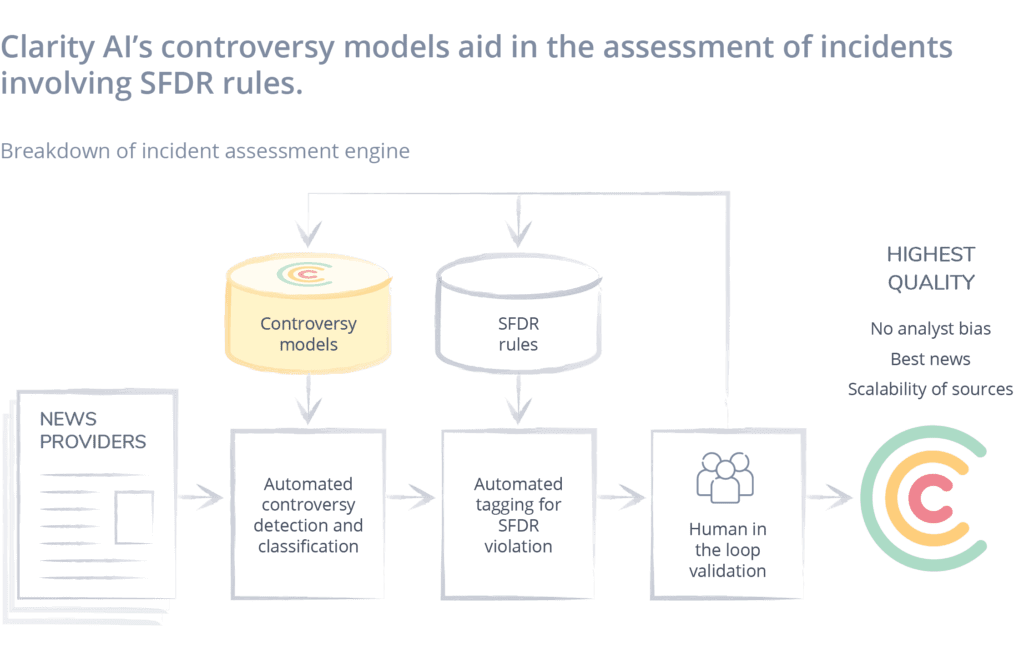
Each of the steps relies on Clarity AI’s proprietary artificial-intelligence models, which are purposefully designed to detect, classify, and assign the corresponding severity. These algorithms are the key factor for our objective analysis, having been trained on subject-matter-expert intelligence through a human-in-the-loop process, with a selection of more than 30,000 articles covering all controversy categories and controversy levels, allowing the model to learn the relevant criteria to be considered in each step.
The combination of this controversy methodology and SFDR rules is illustrated in the following figure: