

KEY TAKEAWAYS
Leveraging technology for corporate sustainability reporting and company ESG scores
Companies are facing an increasing need to highlight and measure their environmental and social activities. Investors, lenders, and regulators are increasing pressure and demanding disclosure of structured and fully transparent non-financial information. McKinsey notes: “As evidence mounts that the financial performance of companies corresponds to how well they contend with environmental, social, governance (ESG), and other non-financial matters, more investors are seeking to determine whether executives are running their businesses with such issues in mind. When companies report on ESG-related activities, they have largely continued to address the diverse interests of their many stakeholders – a long-standing practice that involves compiling extensive sustainability reports and filling out stacks of questionnaires.”
The European Commission is extending the scope and broadening reporting requirements for companies, addressing insufficient, opaque, and non-comparable reporting practices. The regulation will affect nearly 50,000 companies in the EU that need to follow the detailed sustainability reporting standards very soon.
On the other side of the Atlantic, the SEC is exploring mandatory disclosures that will require companies to significantly increase their reporting on climate risk in regulatory filings, enhancing the consistency and comparability of information.
Current ratings used to measure sustainability performance are often flawed and limited. An MIT study highlighted that the divergence in ESG ratings (and thus performance) is not a matter of lacking definitions but rather is based on a “fundamental disagreement about the underlying data.” Companies are therefore often unclear about their “real” performance and can find it difficult to define and measure concrete ESG targets, which are required to communicate sustainability strategic plans and progress against those plans to key stakeholders, such as employees, clients, investors, suppliers, and consumers.
At Clarity AI, we believe in data granularity that equates to full transparency. Moreover, we want to ensure that companies fully understand their own data at that most granular level. Top-down planning can work, but progress against that planning cannot be accurately done without bottom-up data and the tech tools to power the associated, required analysis and reporting.
We have developed a new solution to empower companies with direct access to all their data, full visibility of general methodologies and score inputs, as well as with direct connections to our broad network of investors. Companies can navigate through all available raw data points to review how ESG scores are built and to better understand the data investors use to make allocations. All available data points can be validated and updated directly in our easy-to-use SaaS-based tool, which ensures a reliable and fair view of the company at all times and enables companies to correct inaccuracies that may be costing them allocations from ESG-focused investors.
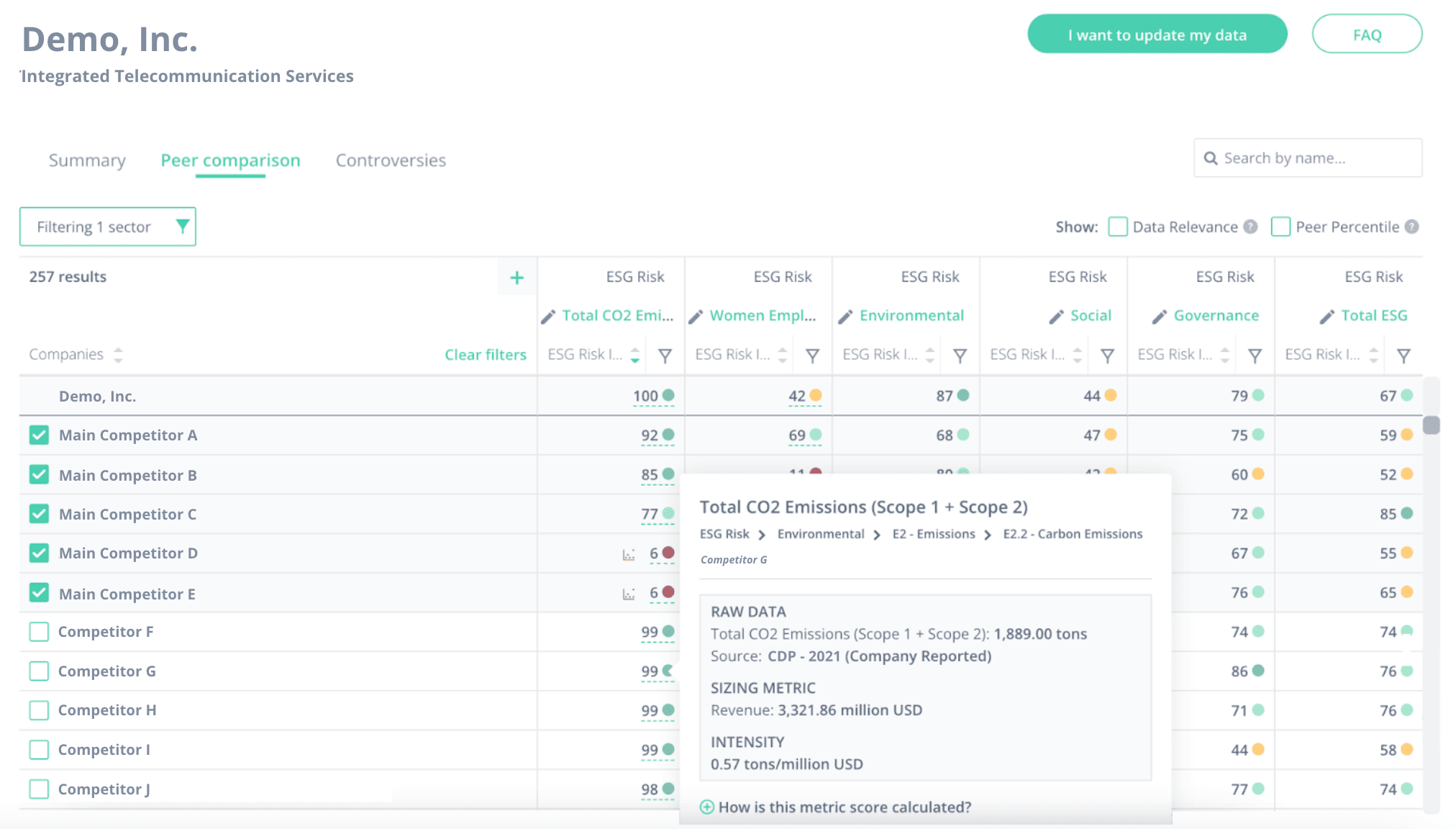
Furthermore, our newly launched benchmarking tool allows companies to generate valuable, tangible insights about their sustainability performance in relation to their peers and offers an effective way to analyze strengths and weaknesses. Companies can use all available information to boost awareness of sustainability efforts internally, ensure compliance with regulations, and communicate sustainability efforts externally to key stakeholders, as mentioned above. Users at each company will be able to:
- Understand and review their company’s own ESG performance in detail
- Identify strengths and key areas of improvement through granular peer and industry benchmarks
- Screen thousands of news articles to assess the impact of sustainability-related reputational risks and be ready to act accordingly
- Keep all metrics up-to-date at any point in time
- Communicate efficiently with investors – using a straightforward process within our easy-to-use tool