
Investors need to perform a dual-lens analysis to ensure true alignment of their investments to the UN Sustainable Development Goals (UN SDGs)
Just as investors do not invest in companies where they know only the assets, and not the liabilities, analysis of solely a company’s SDG assets – the ways in which it is compelling progress – provides an incomplete picture of the company’s societal standing and its capacity to capitalize on SDG opportunities. Its societal liabilities are just as relevant.
With an estimated 4 trillion USD required on an annual basis in developing countries to achieve the Goals, investment in companies truly contributing to the 2030 Agenda for Sustainable Development is more crucial than ever¹. Beyond ethical considerations, pursuing these goals presents a significant business opportunity, from which the public and private sectors can benefit.
Though many investors leverage the SDG framework to inform investment strategies, approaches for assessing alignment are diverse and, sometimes, incomplete. It is undoubtedly important to measure the alignment of companies to understand how investments are positively contributing to society. However, assessing misalignment, which scrutinizes the potentially harmful impact that companies may have is a foundational component of a comprehensive SDG strategy. This approach, leveraging both a positive and negative lens, is a complete means by which to define strategically aligned companies and screen out those companies that hinder SDG progress. Moreover, it allows investors to understand the net benefit of their investments.
Take, for example, a portfolio diversified across low-carbon and traditional energy production companies. An analysis that only accounts for the alignment (positive contribution) of the portfolio indicates a robust 37% percent alignment to the SDGs, with the lion’s share of that alignment derived from contributions to the SDG 7 issue “Cleaner Energy Mix” and the SDG 13 issue “Energy Production Emissions”. In short, through an isolated alignment lens, the portfolio appears to be making a strong, positive contribution to climate change mitigation.

Chart Note: The portfolio contains four funds representing a combined 254 companies across 30 sectors related to either direct energy production or energy production enabling technologies.
However, a very different story emerges when misalignment is factored into the analysis. The portfolio is having a harmful effect on the SDGs, with a misalignment of 48%; the majority of which is derived from misalignment to the very same aforementioned issues. Thus, a portfolio that, at first glance, appeared with a strong base for SDG progress is ultimately revealed to be more harmful to the UN SDGs growth. This insight, critical to ensuring alignment with stakeholder expectations, investment strategies, and the avoidance of impact washing, is only possible with the dual alignment-misalignment lens.
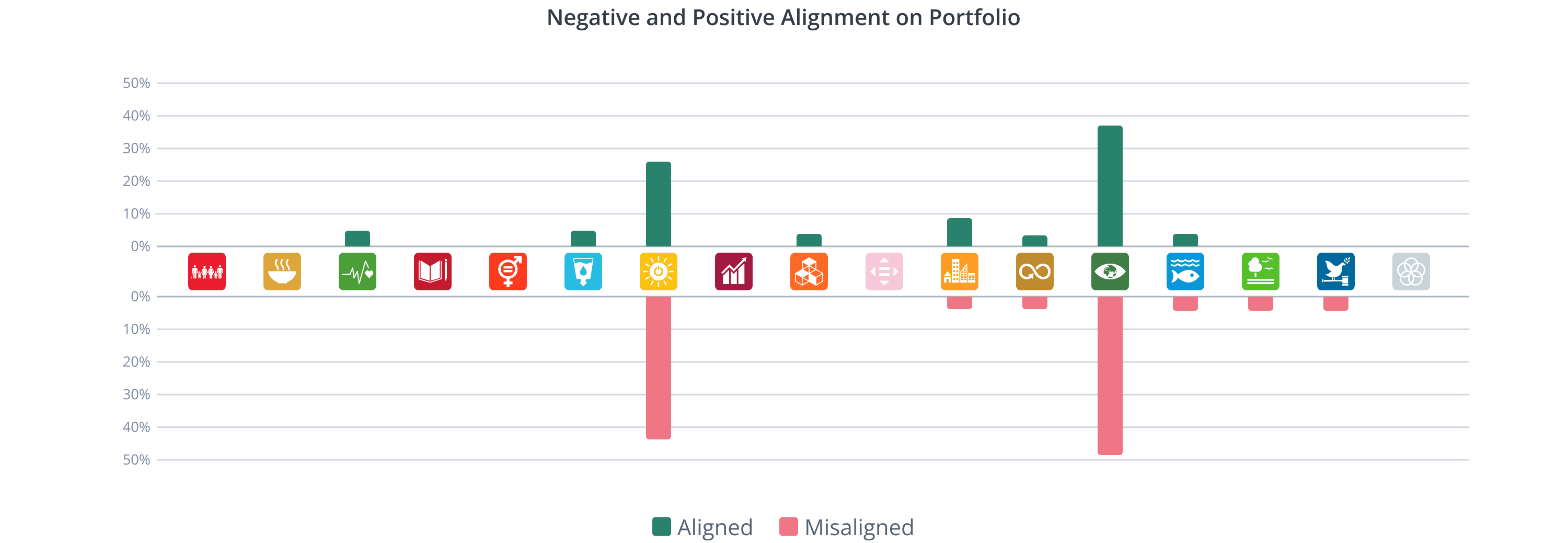
Chart Note: The portfolio contains four funds representing a combined 254 companies across 30 sectors related to either direct energy production or energy production enabling technologies.
In practice: Implementing the dual-analysis in portfolio management
Clarity AI’s Revenue Alignment methodology identifies, quantifies and maps both alignment and misalignment to granular SDG-associated issues. By providing SDG transparency at multiple levels, and leveraging insights from academic and scientific authorities, Clarity AI creates a detailed, yet understandable, framework through which users can ascertain decision-useful investment information. This provides investors with not only the ability to select investments that are aligned with their strategies but also, to screen out investments that negatively impact the SDGs and potentially their strategy. Paired with Clarity AI’s reporting capabilities, this provides a compelling way to communicate to stakeholders the precise means by which investments are addressing SDG-associated issues.
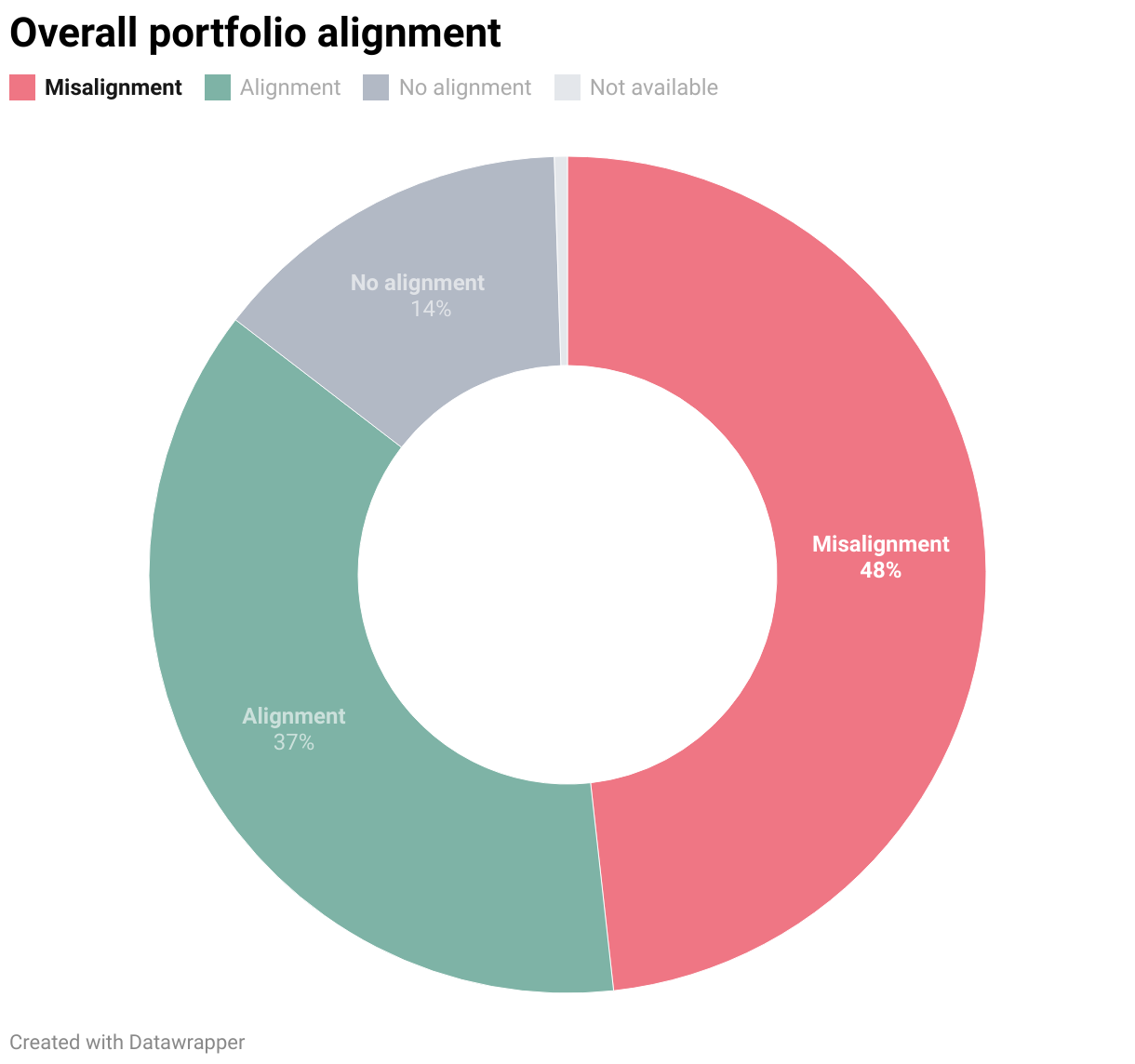
Chart Note: The portfolio contains four funds representing a combined 254 companies across 30 sectors related to either direct energy production or energy production enabling technologies.
As investors increasingly leverage frameworks like the SDGs to meet evolving stakeholder expectations, they must also confront a countervailing increase in stakeholder scrutiny. In this context, the need for transparency and comprehensiveness is paramount. Here, Clarity AI’s UN SDGs Revenue Alignment methodology plays a pivotal role in facilitating informed decision-making and comprehensive reporting. By embracing transparency and granularity, investors can navigate the complexities of sustainable investing with confidence, driving meaningful societal contributions and attracting a new generation of impact-conscious, sophisticated investors.
¹ United Nations Conference on Trade and Development, UN economists, 2023.