

The Answer in Brief
AI powers climate risk intelligence by transforming fragmented, inconsistent data into clear, decision-ready insights for investors. It enables faster integration of climate factors into investment workflows, fills disclosure gaps like Scope 3 emissions, and streamlines regulatory reporting. With AI-driven climate risk intelligence, investors can move beyond static, backward-looking models to proactively identify risks and opportunities in a changing climate.
KEY TAKEAWAYS
The markets are learning what scientists have warned for decades: the impacts of climate change have a price.
In just the first half of 2025, insured losses from natural disasters climbed to USD 126 billion, more than triple the 21st-century average.1
Wildfires, floods, and heatwaves are no longer distant environmental events, they’re shaping valuations, disrupting supply chains, and exposing the limits of risk models built for a more stable planet.
As investors confront data gaps, uneven disclosure standards, and shifting regulations, one question is becoming urgent: how can they keep pace with a risk that moves faster than their forecasts? Increasingly, the answer lies in AI-powered climate risk intelligence, which can process fragmented information and turn it into forward-looking insight.
The Data Dilemma: A Barrier to Action
Assessing climate risk requires integrating complex variables: emissions data, exposure maps, policy trajectories, and corporate transition plans. Yet the data remains fragmented, inconsistent, and incomplete.
Scope 3 emissions — often representing up to 90% of a company’s total carbon footprint — are still inconsistently reported or estimated. Disclosures differ across jurisdictions, methodologies, and timeframes. Investment teams spend countless hours gathering, cleaning, and reconciling information, time that could instead be devoted to strategy and engagement.
This data fragmentation slows climate action precisely when investors need speed, comparability, and clarity. The result is a growing need for climate risk intelligence that can unify and interpret these disparate data sources.
Why AI Is the Turning Point for Climate Risk Intelligence
Artificial intelligence is transforming climate risk management from a backward-looking exercise into a dynamic, data-driven process.
AI doesn’t replace investor judgment, but it can amplify it by processing massive and diverse datasets. This helps analysts discover patterns invisible to manual analysis and turns static reporting into living models that evolve with every new data point.
Here are four ways AI is reshaping climate risk management.
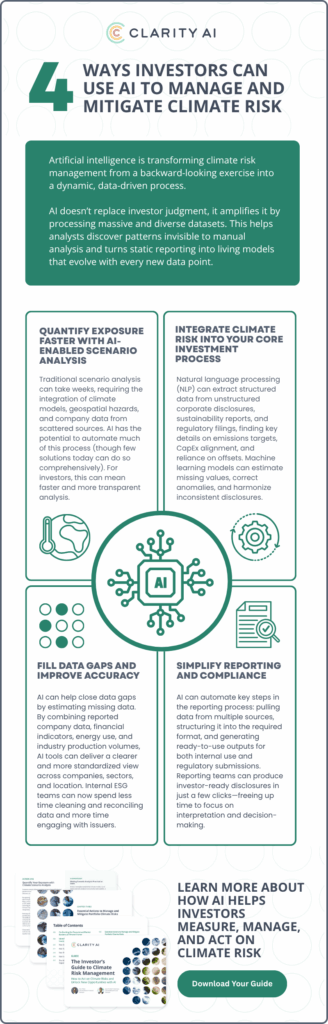
1. Quantify Exposure Faster with AI-Enabled Scenario Analysis
Traditional scenario analysis can take weeks, requiring the integration of climate models, geospatial hazards, and company data from scattered sources. AI has the potential to automate much of this process (though few solutions today can do so comprehensively).
Machine-learning systems can also be trained to ingest and normalize large datasets — such as temperature projections and sector-specific emissions pathways — to simulate how portfolios might perform under 1.5 °C, 2 °C, and 3 °C scenarios.
For investors, the promise is clear: faster and more transparent analysis that transforms complex data into decision-ready insights about how climate risks could shape performance across different time horizons.
2. Leverage AI to Integrate Climate Risk Intelligence into Your Core Investment Processes
Managing climate risk effectively means embedding it into day-to-day investment decision-making rather than treating it as a one-off exercise. Traditional research methods, which rely heavily on manual data collection and static reports, often struggle to keep pace with shifting regulations, evolving corporate strategies, and emerging physical hazards. This lag can leave portfolios exposed to unanticipated risks or missed opportunities.
AI enables investment teams to streamline and scale climate risk integration. Natural language processing (NLP) can extract structured data from unstructured corporate disclosures, sustainability reports, and regulatory filings, revealing key details on emissions targets, capital expenditure alignment, and reliance on offsets.
Machine learning models complement this by focusing on specific climate metrics—such as greenhouse gas (GHG) emissions—where they can estimate missing values, correct anomalies, and harmonize inconsistent disclosures. This not only makes datasets more complete but also enhances their reliability and comparability across companies and portfolios.
Beyond analysis, AI can deliver timely alerts when portfolio exposures change, for example, if a government announces a new carbon pricing policy, a company updates its climate strategy, or a facility faces an imminent physical hazard. This allows portfolio managers to adjust positions or engage with companies before risks materialize. By embedding these capabilities directly into research workflows, investors can make more informed, faster, and more consistent climate-aligned decisions.
3. Fill Data Gaps and Improve Accuracy Across Portfolios
Reliable climate data is the foundation for any meaningful risk assessment or disclosure, yet gaps remain, particularly for Scope 3 emissions, which are often estimated inconsistently or not reported at all. These blind spots make it harder for investors to build an accurate picture of portfolio risk and opportunity.
AI can help close data gaps by estimating missing emissions data through advanced machine learning models, physical activity-based calculations, and interpolation techniques. These methods draw on years of reported emissions, company fundamentals, and industry activity data to generate consistent, comparable estimates where disclosure is incomplete. This approach provides more robust coverage than simple peer benchmarking or sector averages. High-quality, multi-source datasets, validated through rigorous cross-checking, provide greater reliability for decision-making.
By combining reported company data, financial indicators, energy use, and industry production volumes, AI tools can deliver a clearer and more standardized view across companies, sectors, and location. Internal ESG teams can now spend less time cleaning and reconciling data and more time interpreting results and engaging with issuers. With stronger AI-enhanced data pipelines, investors gain a clearer view of where risks are concentrated, how they are changing, and which companies are best positioned to manage them. This improved clarity ultimately supports more confident allocation, engagement, and disclosure strategies.ments, and AI-driven data integration—investment leaders can mitigate downside exposure while positioning portfolios to capture the upside of the low-carbon transition.
4. Simplify Climate Reporting and Compliance
A range of climate disclosure frameworks exists to help investors and financial institutions set and validate net zero strategies, track progress, and assess the climate-related risks of portfolio companies. Organizations that are not yet reporting should identify the frameworks most relevant to their region to prepare for potential reporting requirements and strengthen their ability to manage climate risks.
The challenge, however, is that compliance with these frameworks can still be time-consuming and resource intensive. Collecting the right inputs, ensuring consistency across portfolios, and producing audit-ready outputs often requires extensive manual work.
AI can ease this burden by automating key steps in the reporting process: pulling data from multiple sources, structuring it into the required format, and generating ready-to-use outputs for both internal use and regulatory submissions. Instead of weeks of spreadsheets and manual data consolidation, reporting teams can produce consistent, investor-ready disclosures in just a few clicks—freeing up time to focus on interpretation and decision-making.
How Climate Risk Intelligence Helps Investors See What the Market Misses
Despite growing awareness, climate risk remains systematically undervalued. Research from the IMF and Verisk Maplecroft suggests that up to USD 1.14 trillion in corporate value is concentrated in countries most exposed to climate upheaval, a clear sign that markets are still mispricing risk.2
This mis-pricing creates both a challenge and an opportunity. Investors who leverage AI-driven climate risk intelligence to identify where markets underestimate climate exposure can position themselves to capture upside from credible transition leaders and avoid stranded assets.
As physical, transition, and systemic risks converge, investors need a unified view that connects data to decisions.
AI delivers that clarity, transforming fragmented information into consistent, decision-ready intelligence. It helps investment teams move from reactive compliance to strategic resilience, turning climate risk from a reporting burden into a source of competitive advantage.
Want a deeper dive into tools and frameworks for managing these risks? Download The Investor’s Guide to Climate Risk Management to learn how AI can transform risk into actionable investment insight.
RELATED FAQs
What types of climate data are most important for investors to track?
Investors should monitor both physical risks (like floods, wildfires, and heatwaves) and transition risks (such as carbon pricing, regulation, and technology shifts). Key datasets include Scope 1–3 emissions, asset-level geolocation, sector transition pathways, and policy developments—all of which feed into robust climate risk intelligence models.
Can AI replace traditional risk models?
AI doesn’t replace traditional models; it strengthens them. While conventional models rely on historical data and fixed assumptions, AI can incorporate real-time information, learn from new data, and adapt dynamically as conditions change. This makes AI particularly valuable in a world where climate and market variables evolve faster than static models can update.
How can AI improve the quality of sustainability and climate data?
AI can improve data quality by cleaning, validating, and harmonizing inconsistent disclosures. For example, natural language processing can extract relevant information from corporate filings and sustainability reports, while machine learning algorithms can estimate missing emissions data or correct anomalies. The result is a more complete, comparable, and reliable dataset that supports better investment decisions and regulatory compliance.
Author Information