

New York, November 26th, 2025 – As the world races to decarbonize, a hidden challenge is emerging beneath the surface: growing pressure on water resources. A new study by Clarity AI, the leading global sustainability technology company, with data from CDP, the global environmental disclosure non-profit, reveals that most companies powering the energy transition are failing to disclose or manage their water-related risks, a blind spot that could undermine both sustainability goals and investor confidence.
The research, “The Water Cost of the Energy Transition: Where Corporate Disclosure Falls Short”, analyzed more than 500 publicly listed companies involved in water-intensive technologies such as green hydrogen, biomass, carbon capture and storage (CCUS), and critical minerals. Despite record clean-energy investments surpassing $2.1 trillion in 2024, the study finds that transparency on water risks remains low.
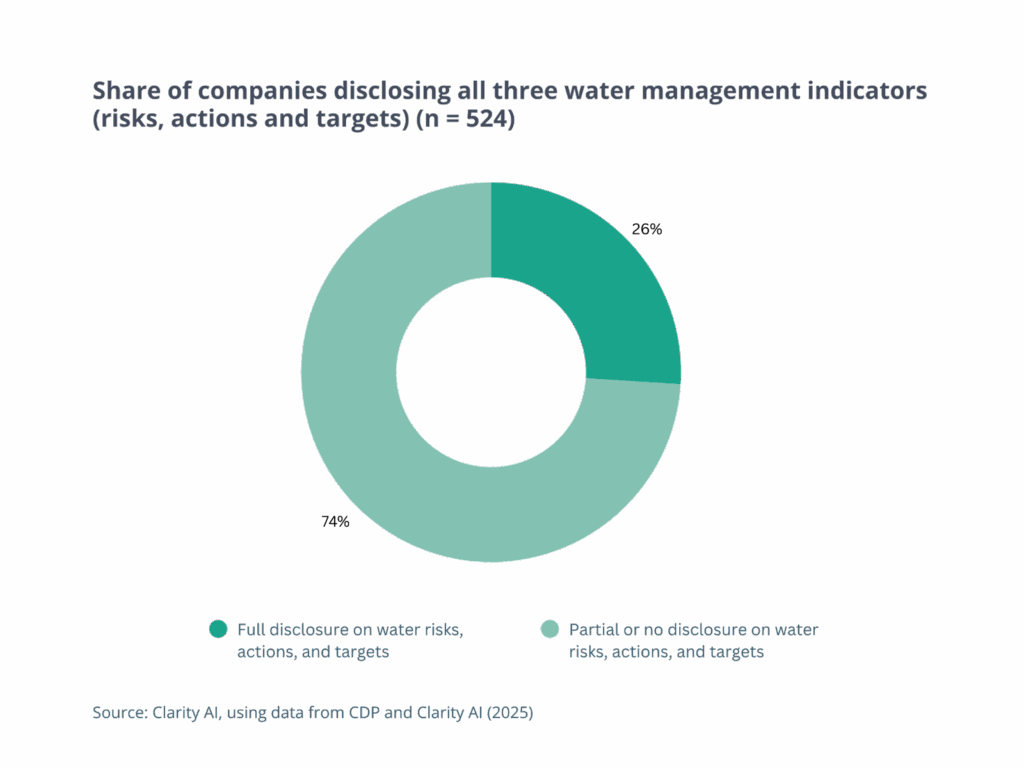
74% of companies overlook water risks
Using Clarity AI’s artificial intelligence models and data from CDP’s Water Security disclosure program, the analysis found that fewer than half of the companies (43%) acknowledge experiencing or anticipating any water-related risks, revealing a widespread blind spot in how the corporate world assesses environmental dependencies.
Even more concerning, only 26% of companies meet best-practice standards — meaning they disclose water-related risks, report concrete mitigation actions and set measurable targets. In other words, three in four companies (74%) fail to provide a full picture of how they manage water risk, leaving investors unable to accurately gauge exposure to one of the most pressing resource challenges of the decade.
“These findings reveal a blind spot in the energy transition,” said Nico Fettes, Climate Research Director at Clarity AI. “Companies are scaling low-carbon technologies without accounting for their water exposure, and investors are funding them without full visibility. This lack of transparency doesn’t just pose an environmental risk; it threatens the credibility and resilience of the entire transition.”
From transparency to action
While the data reveal widespread inaction, the study also shows a clear pattern: when companies start acknowledging water risks, action follows.
Among those recognizing exposure, nearly nine in ten (89%) have already taken steps to mitigate it — from improving efficiency and reusing water to building new treatment infrastructure. Roughly two-thirds (65%) are investing in better water-management systems or securing stable supplies to protect operations in drought-prone regions.
Companies that disclose are also more likely to plan ahead: 64% of those reporting water risks have set specific, measurable targets, with 70% focused on reducing withdrawals and consumption or improving usage efficiency across facilities.
“A rapid and equitable energy transition cannot be delivered without robust water stewardship. Many critical low-carbon technologies depend on secure and sustainable water resources, and recognising this interdependence is essential to achieving net zero while safeguarding global water resilience. By managing water responsibly and transparently, companies can reduce material risks, build more resilient value chains and contribute to an earth-positive transition that is both credible and enduring,” said Joe Ray, Head of Water at CDP.
Sectors and regions: An uneven landscape
Across both technologies and regions the analysis reveals sharp contrasts, exposing where the transparency gap runs deepest.
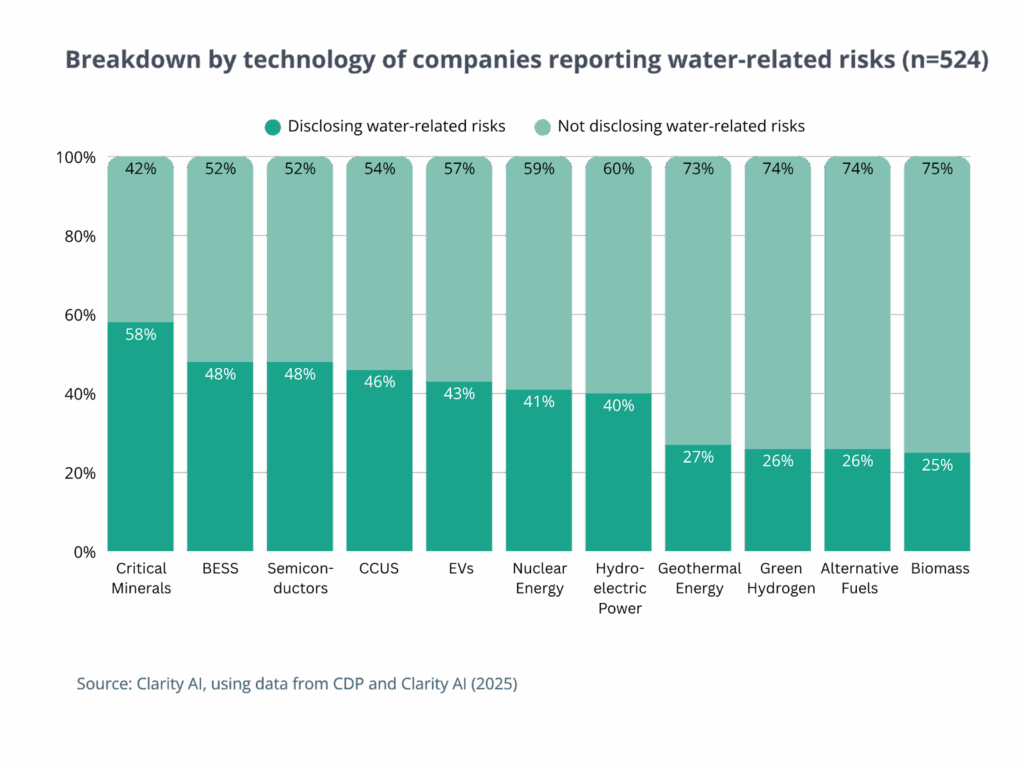
Critical-mineral producers, often operating in water-stressed regions, lead with 57% disclosing water risks, followed by companies in battery storage (48%), semiconductors (48%), and carbon capture, utilization, and storage (46%). By contrast, firms in biomass, green hydrogen, and alternative fuels are far less transparent, with only one in four acknowledging their water exposure. This discrepancy may reflect both location-specific pressures and reluctance among emerging clean-tech sectors to highlight their own water dependencies.
Across regions, the picture is equally uneven. South Asia leads with 67% of companies reporting water risks, driven by high local water stress and growing regulatory awareness. Latin America follows at 52%, while Europe and North America lag at 36–43%, suggesting that even advanced economies may be underestimating their vulnerability to water scarcity.
For more information or to access the full research, please visit: https://clarity.ai
About Clarity AI
Clarity AI is the leading sustainability tech company, leveraging advanced technology and AI to provide data-driven environmental and social insights to investors, corporates, governments, and consumers. AI has been at the core of Clarity AI’s offering from the start, supporting a fully flexible set of data solutions, insights, analytics capabilities, and tools used for portfolio management, corporate research and engagement, benchmarking, regulatory reporting, online banking, and e-commerce.
Within the investment sector, Clarity AI serves a direct network of clients managing around $55 trillion in assets and includes firms like Nordea, Crédit Agricole, PGIM, or Santander. Our strategic partnerships with financial institutions such as BlackRock, BNP Paribas, Caceis, or SimCorp, allow thousands of users to access Clarity AI advanced data analytics capabilities through their usual investment platforms, ensuring a seamless workflow experience. Clarity AI has offices in Europe, North America, and the Middle East. For more information visit www.clarity.ai
About CDP
CDP is a global non-profit that runs the world’s only independent environmental disclosure system. As the founder of environmental reporting, we believe in transparency and the power of data to drive change. Partnering with leaders in enterprise, capital, policy and science, we surface the information needed to enable Earth-positive decisions. We helped more than 24,800 companies and almost 1,000 cities, states and regions disclose their environmental impacts in 2024. Financial institutions with more than a quarter of the world’s institutional assets use CDP data to help inform investment and lending decisions. Aligned with the ISSB’s climate standard, IFRS S2, as its foundational baseline, CDP integrates best practice reporting standards and frameworks in one place. Our team is truly global, united by our shared desire to build a world where people, planet and profit are truly balanced. Visit CDP.net or follow us @CDP to find out more.
Contact Information:
For any related inquiries, please contact:
media@clarity.ai


