As a new age of finance dawns, so, too, does a new brand of financial ethics.
Financial ethics describe of an acceptable code of conduct that ensures a level playing field for all stakeholders as a basis for fair treatment in the financial system.
But these ethics are evolving in lockstep with society.
What are modern financial ethics?
Financial ethics aren’t a static concept. The financial and banking sectors are undergoing a reconfiguration as the climate crisis tightens its grip on all facets of daily life.
Environmental factors now play an increasing role in business strategy. Social responsibility is living right alongside its fiscal counterpart in many organizations. The status quo is moving.
Traditionally, financial ethics have dealt with the handling of material non-public information and reporting of the unethical act.
Consider modern financial ethics an update to that philosophy that incorporates environmental, societal, and governance factors as important aspects of ethical decision-making for financial institutions.
Responsible investing is an example of modern financial ethics in practice. As investors better grasp the impact of their investments, many are choosing to apply a new kind of reasoning to the way they allocate resources.
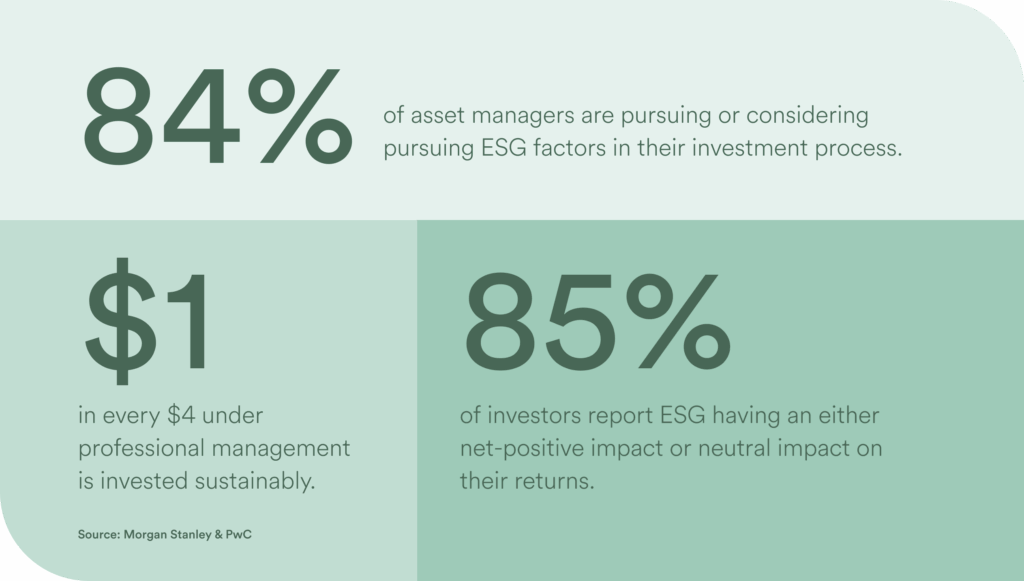
When faced with the decision between fossil fuel and clean energy investments, a modern take on financial ethics helps to steer decisions into a fairer direction, working to ensure the prosperity of current and future generations.
72% of institutional investors now consider ESG metrics as an integral part of their fiduciary duty, a notable acceleration in the influence of ESG in finance in recent years as it works its work into the very DNA of finance itself.
“Acting in a financially ethical way is a good that compounds.”
The widely used acronym sets standards for an expanded sense of perception businesses of the future are embracing.
Adhering to ethical standards is not a one-off deal. Staying on ethically-sound footing requires financial institutions remain open to adapting new perspectives into their ethical guidelines as public opinion evolves.
Why are ethics in finance important?
While financial ethics don’t exclusively govern whether something falls along legal lines, these two realities often coincide. A useful schematic would be to think of them as a compass to navigate between good and bad choices.
In complex situations, they help keep course. In delicate dilemmas, they inform a wiser way forward. In the grand scheme of things, they are the lubricant that keeps the global capital machine running.
Without it, financial systems around the world would cease to function. The trust we instill in the system to responsibly handle our money is vital to ensuring the system survives.
Staying above board reduces the risk a company falls victim to reputational disaster, legal crises, and overall questions of legitimacy, problems that are far from envious.
Acting in a financially ethical way is a good that compounds. Strong ethics influence corporate governance, trickling down to set the tone for employee behavior. A strong culture based on shared, transparent values starts at the top.
Embracing values of honesty and integrity are integral parts of the DNA that compose modern financial ethics. By extending ethics to include environmental and social considerations, financial institutions can build upon their efforts, leaving the world and their companies a better place.
Author Information