Are Corporate Boards Truly Ready to Govern Climate Risk?
By and large, no. While a small minority of boards take ownership of the issue, most are not yet equipped to independently drive climate strategy. Because climate risk is outside the comfort zone of the average director, boards often rely on management to do the “heavy lifting” while they simply go along for the ride. To become truly ready, directors need active education from external experts, strong leadership from their chair, and structurally empowered committees to navigate the complexities and increasing politicization of the climate transition.
Listen on your favourite network



When the US officially left the Paris Agreement, it didn’t just upend global climate diplomacy.1 It sent immediate shockwaves through corporate boardrooms. Add in the disappointing reality check of COP30,2 and the recent wave of high-profile financial institutions exiting alliances like Climate Action 100+,3 and the message to businesses has become incredibly complicated. For corporate directors, the question is no longer just how to transition, but whether to stand their ground publicly or keep their heads down to survive the crossfire.
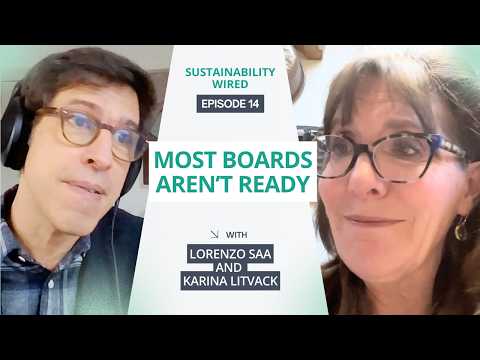
In the latest episode of Sustainability Wired, host Lorenzo Saa sits down with Karina Litvack, an experienced corporate board member and sustainable investment pioneer, to unpack what effective climate governance actually looks like when the political temperature is rising. Drawing on 15 years as a sustainable investor and her time on the board of a major oil and gas company, Karina explains why navigating this climate reality isn’t just a management task, but rather a fundamental board responsibility.
From the absolute necessity of strong chair leadership to the corrosive impact of “greenhushing” on corporate morale and external stakeholder messaging , the conversation reveals why collective action matters more than ever. It also tackles the complex intersection of climate and AI, exploring how the massive energy demands of data centers must be balanced with AI’s potential to drive smarter strategic choices.
Most importantly, the episode explores how institutional investors can break through the corporate veil. Karina challenges investors to drop lazy, generic engagement templates and start demanding direct access to boards to ensure their expectations aren’t filtered out by management.
Listen in to learn why boards desperately need to upskill on climate science , why leaving net-zero alliances makes it harder for everyone else, and how investors can turn board-level engagement into concrete accountability.
Key Moments
| 00:43 | Introduction: the geopolitical context, COP 30, and the Paris Agreement |
| 02:24 | Karina’s journey from urban regeneration to ethical investment |
| 07:09 | The three pillars of successful climate governance |
| 12:10 | What is climate governance and are corporate boards addressing it? |
| 15:05 | The debate over standing your ground versus greenhushing |
| 18:18 | The evolution and fracturing of Net Zero alliances |
| 21:45 | Three ways institutional investors can empower boards |
| 25:52 | The role of stewardship and internal investor alignment |
| 28:50 | How to distinguish between advocacy and climate governance |
| 30:56 | The elevator pitch for the Chapter Zero Alliance |
| 32:35 | Board preparedness for AI and its environmental impact |
| 37:41 | Art and sustainability: The story of Haitian oil drum artisans |
| 41:30 | Quick fire questions |
| 45:10 | Closing statements |
Notable Quotes and Insights
Throughout the conversation, Karina Litvack offers a candid look at what effective climate governance truly requires from corporate boards, moving beyond surface-level sustainability reports to the realities of committee delegation, continuous education, and direct investor engagement. Her insights highlight where boardroom climate strategies are currently falling short, the dangers of yielding to political pressure through greenhushing, and why balancing pragmatic risk management with unwavering ambition is essential. The following quotes capture the key moments that illustrate how directors and institutional investors can work together to turn corporate climate commitments into concrete accountability and action.
1. There Are Three Pillars of Successful Climate Governance
Effective climate action at the board level requires three key elements: strong leadership from the chair, a willingness among directors to seek external education, and structural empowerment. Specifically, delegating climate responsibilities to a dedicated, cross-communicating committee gives the board the targeted focus and bandwidth these complex issues demand.
“So in some boards and in my boards, I have found that it’s most effective to delegate to a committee the responsibility for really digging into these issues. And the reason I have found that that works better is because although it is always the responsibility of the entire board and it has to flow back up to the entire board and decisions need to be taken by the entire board, the entire board does not have the time or the bandwidth to dig deep into these issues.”
2. Most Boards Are Not Taking Ownership of Climate Governance
While a small minority of boards take climate risk seriously, most still rely on management to do the heavy lifting. Instead of actively driving the strategy, boards often just go along for the ride when they should be collaborating with management to set goals and measure progress. This inaction is worsened by today’s highly politicized environment, but directors must remember that the laws of science remain constant regardless of political shifts.
“At best, what happens is that you have management that will do this reasonably well with the board kind of going along for the ride. But it’s pretty unusual that the board should drive this in the way that I think it needs to… We have entered a period of unusual confusion and policy flip-flopping and politicization of a topic that is above politics… And we have to, of course, remind ourselves that the laws of science don’t change, even if the political context does.”
3. Investors Need Tailored Strategies and Direct Board Access
Institutional investors hold more influence over corporate climate action than they realize, but they must put in the work to be effective. Instead of relying on lazy, template-based questions, investors should prioritize depth over breadth and tailor their approach to each specific company. Furthermore, investors must demand direct access to the board itself, as management teams often filter out criticism and leave directors with a sanitized view of what investors actually expect.
“And the other thing I would really implore investors to do is to ask to speak to the boards directly. Because we are, with the exception of the UK and maybe the Netherlands, you know, and the larger companies, we in boards are heavily intermediated by management, investor relations and CFO or CEO. And so we don’t have direct contact with investors. And that means that we have a very kind of fuzzy view of what investors expect of us specifically.”
4. Investors Need Tailored Strategies and Direct Board Access
While many claim the 1.5 degree climate target is dead, giving up on it entirely is a dangerous mistake. Companies and governments must responsibly prepare for a world that exceeds two degrees of warming. However, this preparation must be paired with an unwavering commitment to strive for the 1.5 degree goal, reconciling practical risk management with necessary ambition.
“There’s a lot of talk about how 1.5 is dead. And it reminds me of that saying that you prepare for war, but you strive for peace…It’s similar with this in the sense that we have to prepare for a world that fails to meet the 1.5 degree target.
We have to—at a governmental level, at a corporate level, at a societal level—prepare for a world that gets up to beyond two degrees. It would be grossly irresponsible not to, but that does not mean that we give up making every conceivable effort to stay within that very narrow corridor that will lead us to 1.5 degrees. So this is how I reconcile these two concepts of realism and aspiration.
You cannot have one without the other.”
Discover how AI helps investors measure, manage, and act on climate risk.
Download Guide
References
- Sarah, Schonhardt. “So long, Paris: US officially leaves landmark climate pact.”Politico. January 27, 2026. https://www.politico.com/news/2026/01/27/so-long-paris-u-s-officially-leaves-landmark-climate-pact-00746628
- David Waskow et al., “Beyond the Headlines: COP30’s Outcomes and Disappointments,” World Resources Institute. November 25, 2025, https://www.wri.org/insights/cop30-outcomes-next-steps.
- Aysha Gilmore. “JP Morgan and State Street exit CA100+ as BlackRock steps back.” Net Zero Investor. February 16, 2024. https://www.netzeroinvestor.net/news-and-views/briefs/jp-morgan-and-state-street-exit-ca100-as-blackrock-steps-back
Author Information